

SEO for dentists is the work that helps your surgery show up on Google when patients search for dental care. It improves your ranking in local results, Google Maps and organic listings. The goal is simple. More patients find you, and more of them book.
That is the plain-English answer. No jargon, no buzzwords. Now let me walk you through how it actually works, what it includes, and whether it is worth your money.
| Topic | Key point |
|---|---|
| What it is | Work that helps your surgery rank higher on Google |
| Why it matters | Most patients search online before booking a dentist |
| Local SEO | Puts you in the Map Pack via your Google Business Profile |
| On-page SEO | One clear, optimised page per treatment |
| Technical SEO | Site speed, mobile and schema under the bonnet |
| Link building | Quality backlinks build trust and authority |
| Reviews | Rating, count and recency drive rankings and bookings |
| SEO vs Ads | SEO is owning; Ads is renting. Many use both |
| Worth it? | Yes for most surgeries, as a long-term investment |
SEO in one minute
Think of Google as a giant directory. When someone searches “dentist near me”, Google picks which surgeries to show first. SEO is how you earn one of those top spots.
The letters stand for search engine optimisation. In plain terms, it means making your website and listings easy for Google to trust and rank. The better you optimise, the higher you appear.
Higher rankings mean more clicks. More clicks mean more enquiries. That is the whole point of SEO for dentists, and it is why busy practices invest in it.
Why dental practices need SEO
Patients research before they book. Most start on Google, not on a recommendation. If you are not visible, you simply do not get the call.
The numbers back this up. Around 70% of people search for a dentist online before scheduling an appointment. Most then contact a surgery soon after searching.
Dentistry is also intensely local. Patients want someone nearby, reputable and available. They rarely scroll past the top three local results, so your position decides who wins the patient.
SEO for dentists is not the same as general SEO
Dental SEO has its own rules. Patients search differently, and Google treats local healthcare with extra care. A generic agency often misses these details.
For one, the searches are local and urgent. People type “emergency dentist near me” or “Invisalign dentist [city]”. Each search needs the right page and the right local signals.
For another, trust matters more in healthcare. Google leans hard on reviews, accurate information and credibility. That is why working with a dentist-focused team usually beats a one-size-fits-all agency.
A Beginner’s Guide to SEO for Dentists in the UK
New to all this? Start small and build up. You do not need to master everything at once.
Begin with three simple wins. Claim your Google Business Profile, fix your contact details everywhere, and ask patients for reviews. These steps alone lift many UK surgeries in local results.
Next, look at your website. Make sure it loads fast and works on phones. Then give each treatment its own clear page, written for patients across England, Scotland and Wales.
Keep it steady, not rushed. SEO rewards consistency over time. A little work each month beats a big push that fizzles out.
The main parts of SEO for dentists
SEO is not one task. It is several moving parts working together. Let me break them down in plain English.
1. Local SEO and your Google Business Profile
This is the big one for dentists. Local SEO puts you in the Map Pack, the box of three results near the top. Most local patients click straight from there.
Your Google Business Profile sits at the heart of this. You claim it, fill it out fully and keep it active. Accurate hours, services, categories and photos all help you rank.
Consistency matters too. Your name, address and phone number must match everywhere online. This is called NAP consistency, and Google uses it to trust you.
2. On-page SEO
On-page SEO is the work on your actual web pages. It helps Google understand what each page is about. It also helps patients find exactly what they need.
The key idea is one page per treatment. Implants, whitening, Invisalign and emergencies each deserve their own page. Each page then targets its own search terms.
Good on-page SEO also covers titles, headings and clear content. Pages should answer real patient questions. Then they should guide the visitor toward booking.
3. Technical SEO
Technical SEO is the engine under the bonnet. Patients never see it, but Google does. A slow or broken site struggles to rank, no matter how good the content.
This work covers site speed, mobile layout and clean structure. It also includes schema markup, which helps Google show your hours and reviews. Strong technical SEO keeps everything running smoothly.
Mobile is especially important here. Most dental searches happen on phones, often in urgent moments. A fast, tap-friendly site keeps those patients moving toward you.
4. Off-page SEO and link building
Off-page SEO is what happens away from your website. The main piece is backlinks, which are links from other trusted sites to yours. Google reads them as votes of confidence.
Quality beats quantity every time. A few links from respected UK health and dental sites carry real weight. Dodgy, spammy links can actually hurt you.
A careful link building plan builds your authority over time. This authority helps you outrank competitors for tougher search terms.
5. Reviews and reputation
Reviews are part SEO signal, part sales tool. Google rewards surgeries with strong, recent reviews. Patients trust them when choosing who to call.
Rating, count and recency all matter. A steady flow of fresh five-star reviews builds momentum. So ask happy patients to leave one, every single week.
Responding matters too. A polite reply to every review shows you care. It also signals to Google that your profile is active and trusted.
Advanced SEO for Dentists: Going Beyond the Basics
Once the basics are solid, you can push further. This is where surgeries pull ahead of local rivals. The gains are slower, but they last.
Advanced work starts with content depth. You build guides that answer real patient questions and earn trust. This supports E-E-A-T, the experience and authority signals Google rewards.
It also means smarter link building from respected UK health sites. Add schema markup, competitor gap analysis and rank tracking. For a tailored plan, an SEO consultation maps the next moves.
How SEO for dentists works step by step
So how does a project actually run? Here is the simple version. No jargon, just the flow.
Step 1: The audit
First comes the audit. A good team reviews your website, profile and local rankings. This shows where you are losing patients and why.
They check your site speed, mobile layout and page content. They look at your Google Business Profile and reviews. They also see which keywords your competitors rank for that you do not.
You get a clear picture, not a vague promise. You can start with a free SEO audit to see your own gaps. It costs nothing and shows exactly what needs fixing.
Step 2: The strategy
Next comes the strategy. The team builds a plan around your location, services and goals. No copy-paste templates here.
The plan sets priorities in order. It picks the keywords worth chasing first. It maps which treatment pages to build and which local areas to target.
You see the plan before any work starts. So you always know what is happening and why. There are no surprises down the line.
Step 3: The work
Then the team does the actual work. This is where rankings start to move. It happens across several fronts at once.
On the page, they fix titles, content and treatment pages. On your profile, they optimise your Google Business Profile and build reviews. Behind the scenes, they handle technical fixes and steady link building.
You focus on patients while they handle the rest. The work continues month after month. SEO is ongoing, not a one-off job.
Step 4: The reports
Finally come the reports. Clear monthly updates show your rankings, traffic and enquiries. You see progress in plain English.
Good reports skip the jargon. They show what improved, what is next and what it means for bookings. No ticket systems, no waiting days for an answer.
This keeps you in control the whole way. You always know what is working. And you can ask your account manager anything, anytime.
SEO versus Google Ads
Patients often ask how SEO differs from paid ads. Both get you found on Google. But they work in opposite ways.
Google Ads are like renting. You pay for each click, and the traffic stops when the budget does. The results are fast, but the cost adds up quickly.
SEO is like owning. It takes longer to build, but the rankings keep working for you. Many surgeries use both, with Google Ads for quick wins and SEO for long-term growth.
Is SEO for dentists worth it?
This is the question every practice owner asks. The honest answer is yes, for most surgeries. But it is a long-term investment, not a quick fix.
SEO compounds over time. Each month of work builds on the last. A surgery that ranks well captures patients month after month, without paying per click.
The return can be strong too. Organic search often delivers more leads than paid ads over time. When patients trust the top results, those rankings turn into booked chairs.
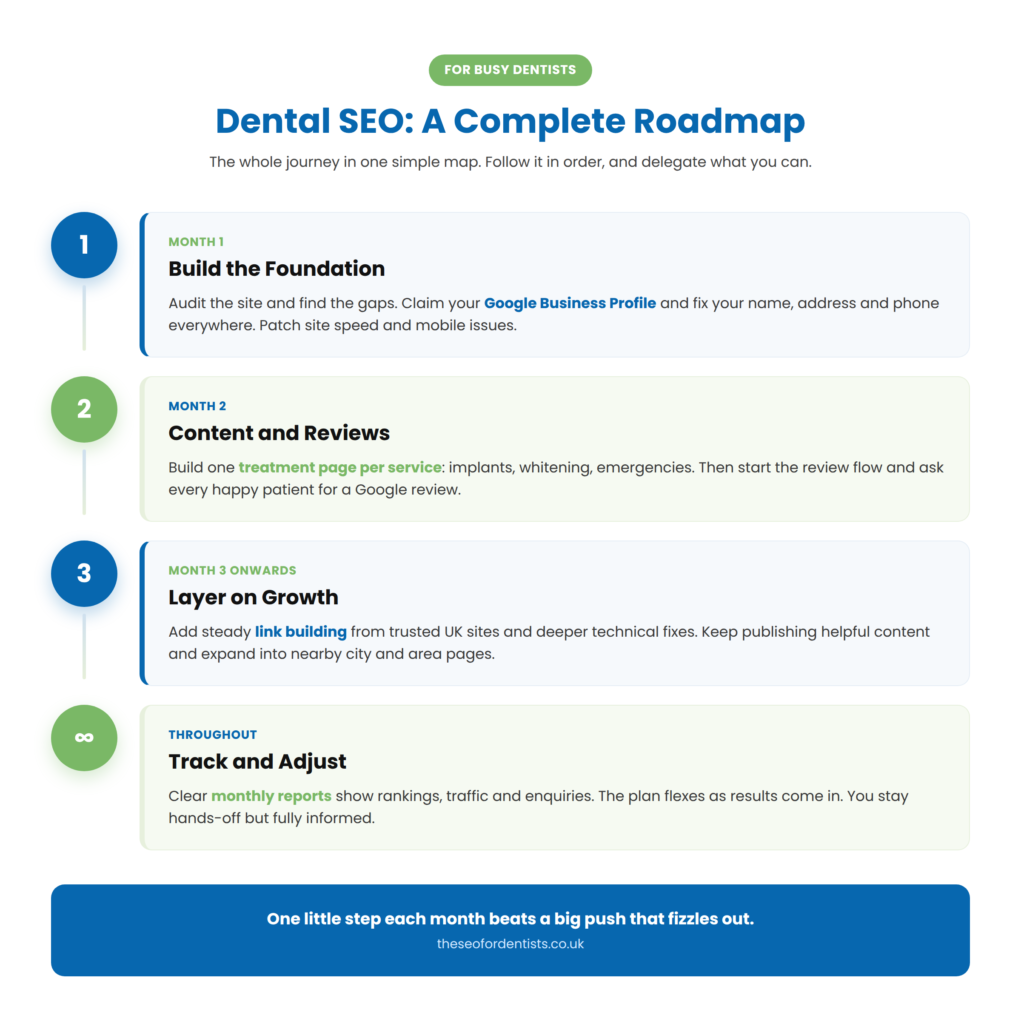
Dental SEO: Roadmap for Busy Dentists
Short on time? Here is the whole journey in one simple map. Follow it in order, and delegate what you can.
How to get started
Getting started is easier than it sounds. You do not have to fix everything at once. You build momentum step by step.
Start with the basics that move the needle. Claim and optimise your Google Business Profile. Keep your details consistent, and build a steady stream of reviews.
Then strengthen the foundations. A fast website with strong treatment pages helps you rank for high-value searches. If you want a clear plan, book a free SEO audit and see exactly where to begin.
Frequently asked questions
What is SEO for dentists in simple terms?
It is the work that helps your surgery rank higher on Google. Better rankings mean more patients find you, and more of them book an appointment.
How long does dental SEO take to work?
Most surgeries see early movement within a few months. SEO compounds, so the biggest gains usually arrive after six to twelve months of steady work.
How much does SEO for dentists cost?
Costs vary by competition and goals, not a fixed price. A good agency sets pricing to deliver a clear return, with no hidden fees or lock-in contracts.
Can I do dental SEO myself?
You can handle the basics, like your profile and reviews. The technical work, content and link building usually need expert help to compete well.
Is SEO better than Google Ads for dentists?
They serve different goals. Ads bring fast traffic you pay for, while SEO builds lasting rankings. Many surgeries use both together for the best result.
Why is dental SEO different from normal SEO?
Dental searches are local, urgent and trust-driven. Google weighs reviews and accuracy heavily, so dental SEO needs local signals a general agency often misses.
Does my surgery really need SEO?
If patients search for a dentist in your area, then yes. Without visibility in the top local results, those patients book with a competitor instead.
